COBBLESTONE SOFTWARE
Contract Insight — User Guide
Requests
Configuration Group: Requests
Note: Each procedure in this guide begins at the Contract Insight homepage, so any section can be followed on its own. Some settings in this group depend on the Purchase Order Optional Add-On Module, so the exact behavior on any one system may vary.
1. Overview
The Requests configuration group holds the settings that control how request records behave across Contract Insight. It governs what appears on the Request Details screen, whether request statuses can be changed there and whether system emails follow those changes, how line items are added, the content and timing of request task email alerts, one-off email behavior, and the help content shown when searching for catalog items.
Requests contains 20 settings, organized under six subsection headings in the settings panel: CONTRACTS, GENERAL, ITEMS, ONE-OFF EMAILS, TASKS, and TIMERS.
As with every configuration group, each setting is presented as a single row containing:
- The name of the application setting
- A description of what the setting does
- An editing control holding the current value — a toggle, a text box, a numeric text box, a dropdown, or an Edit content button for rich-text settings
- A “Last changed” line recording when the setting was last modified and by whom
Because the Requests group is maintained from the Administration area, only Application Administrators — or other users specifically granted the appropriate permission — can view and change these values.
2. Accessing the Requests Configuration Group
The Requests settings are reached through Application Settings. To open them:
- From the Contract Insight homepage, click Administration at the bottom of the left navigation menu.
- On the Administration page, under Configuration & Fields, select Application Settings.
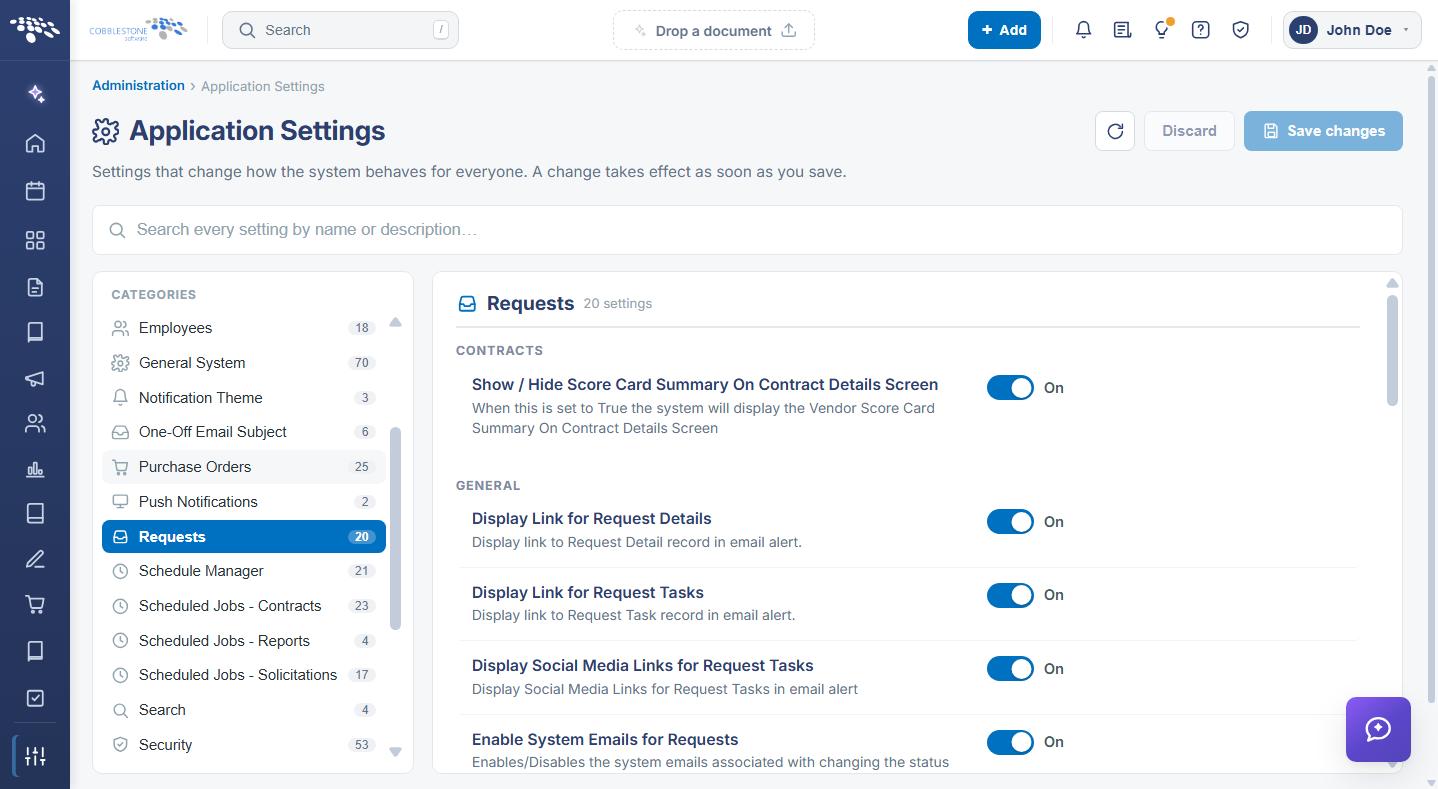
- In the CATEGORIES rail on the left, click Requests. The category is highlighted, and the count beside it shows the number of settings it contains.
- The settings panel on the right is headed Requests with its setting count, and lists the settings under their subsection headings.
.png)
A specific setting can also be reached without browsing the category, by typing part of its name or description into the Search box at the top of the Application Settings screen.
3. CONTRACTS Settings
The CONTRACTS subsection contains a single setting:
- Show / Hide Score Card Summary On Contract Details Screen — When set to On, the system displays the Vendor Score Card Summary on the Contract Details screen. Toggle.
4. GENERAL Settings
The GENERAL subsection controls what appears on the Request Details screen, which links are included in request email alerts, whether status changes and their system emails are permitted, and how line items are added.
The GENERAL settings are:
- Display Link for Request Details — Displays a link to the request detail record in the email alert. Toggle.
- Display Link for Request Tasks — Displays a link to the request task record in the email alert. Toggle.
- Display Social Media Links for Request Tasks — Displays social media links for request tasks in the email alert. Toggle.
- Enable System Emails for Requests — Enables or disables the system emails associated with changing the status of a request. Toggle.
- Request Details Page Status Changes — Enables or disables the ability to change the status of a request from the details page. Toggle.
- Show Budget/Spend Alerts on Request Details Screen — Displays Budget/Spend Alert warnings at the top of the Request Details screen where the Purchase Order module is purchased. The default is On, which shows the alerts. Toggle.
- Line Item Type for PO and Request — Selects whether line items are added as free text or by selection from the “Catalog & Items” setup area. Selected from a dropdown.
- Reply To Address for Request Tasks — The email address used as the Reply To on all scheduled request-related task email alerts. Entered in a text box.
The Line Item Type for PO and Request options are:
- Free Text — line items are keyed directly as free text
- Items Table — line items are selected from the items table configured in the “Catalog & Items” setup area
- Shopping Cart — line items are added through a shopping cart experience
Note: The two status settings work together: Request Details Page Status Changes determines whether a status can be changed from the details page at all, and Enable System Emails for Requests determines whether that change generates a system email.
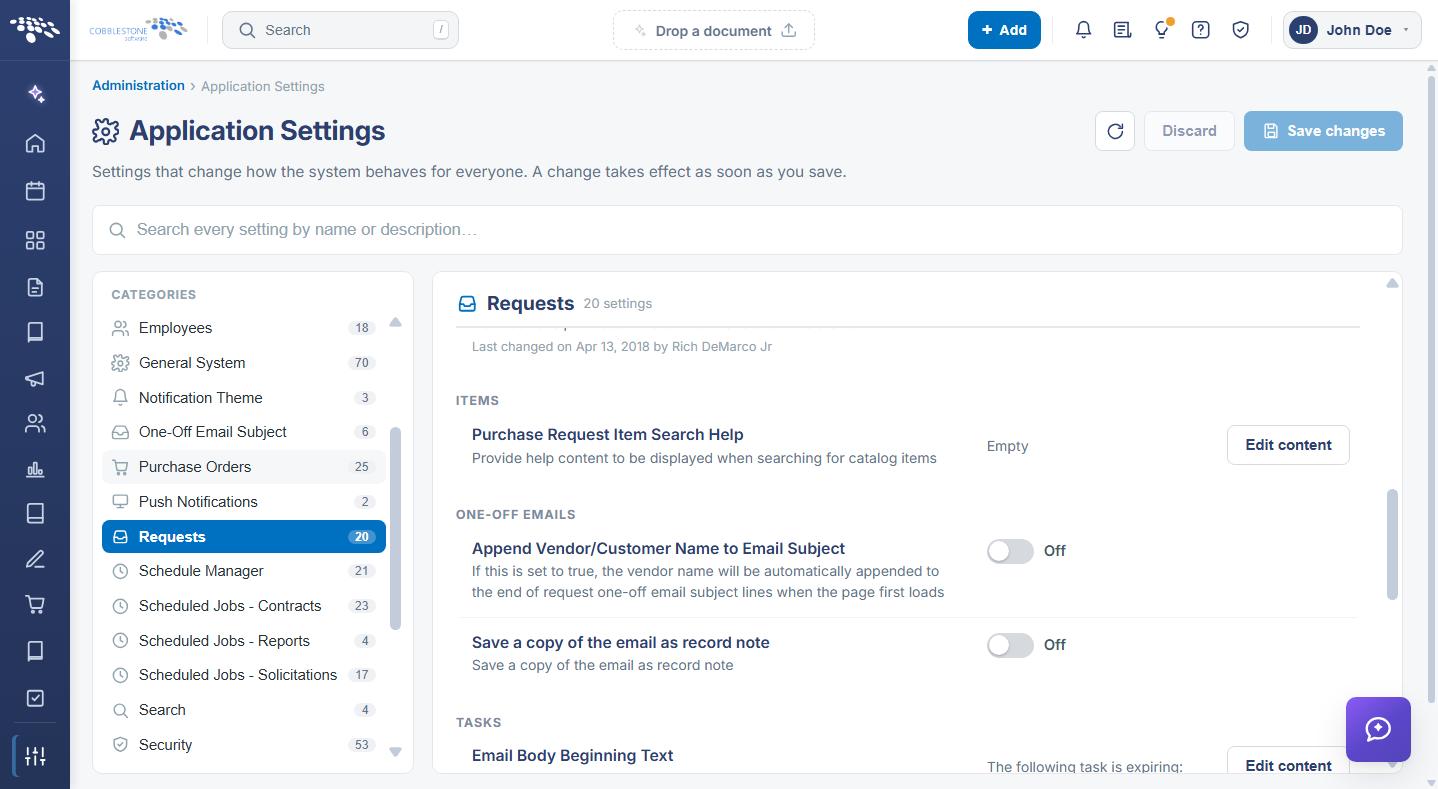
5. ITEMS Settings
The ITEMS subsection contains a single setting:
- Purchase Request Item Search Help — Help content displayed when a user searches for catalog items. Edited through the rich-text editor using Edit content.
6. ONE-OFF EMAILS Settings
The ONE-OFF EMAILS subsection controls one-off emails sent from a request record:
- Append Vendor/Customer Name to Email Subject — When set to On, the vendor name is automatically appended to the end of request one-off email subject lines when the page first loads. Toggle.
- Save a copy of the email as record note — Saves a copy of the email as a note on the record. Toggle.
7. TASKS Settings
The TASKS subsection controls the content of request task email alerts and how tasks are presented on the task grid.
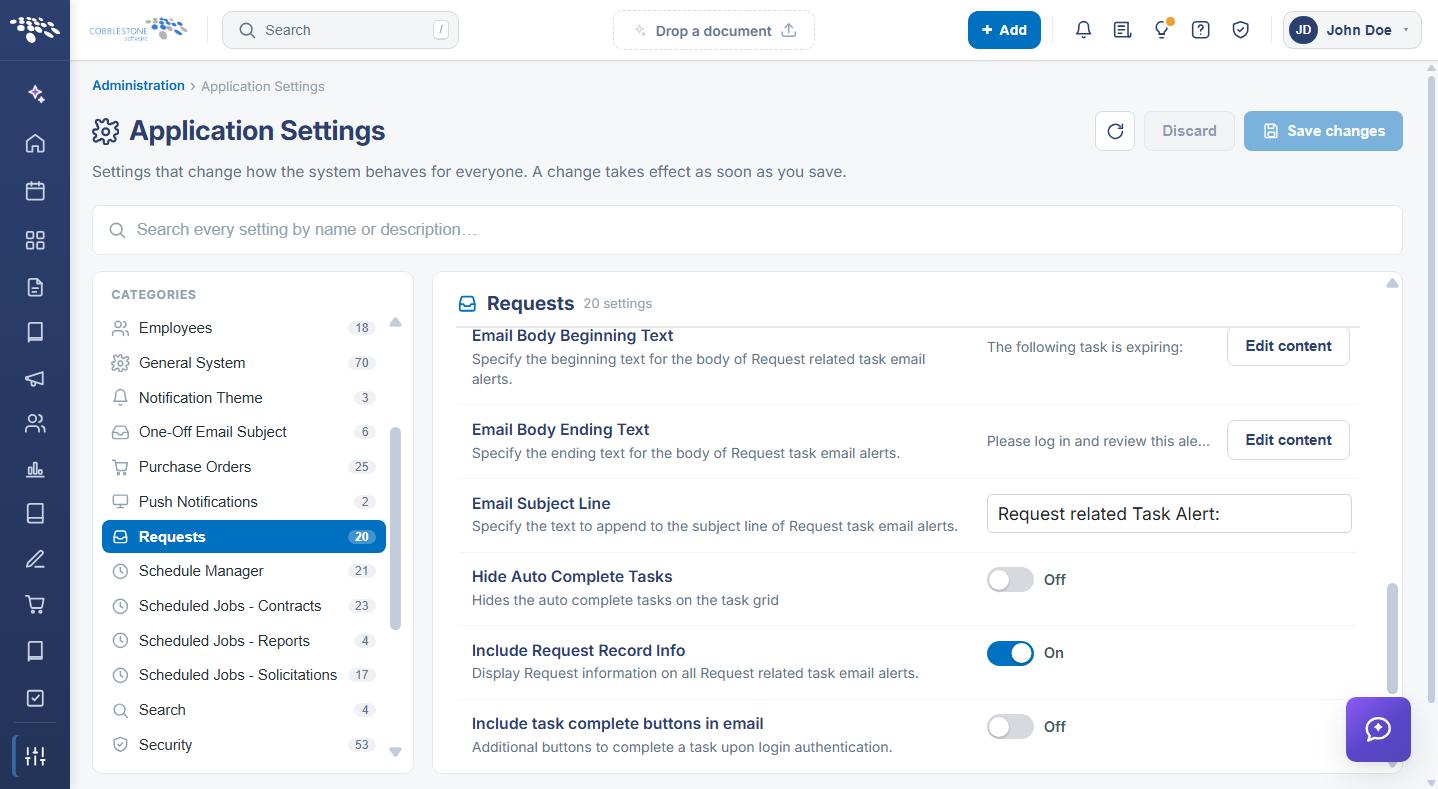
The TASKS settings are:
- Email Body Beginning Text — The beginning text for the body of request-related task email alerts. Edited through the rich-text editor using Edit content.
- Email Body Ending Text — The ending text for the body of request task email alerts. Edited through the rich-text editor using Edit content.
- Email Subject Line — The text appended to the subject line of request task email alerts. Entered in a text box.
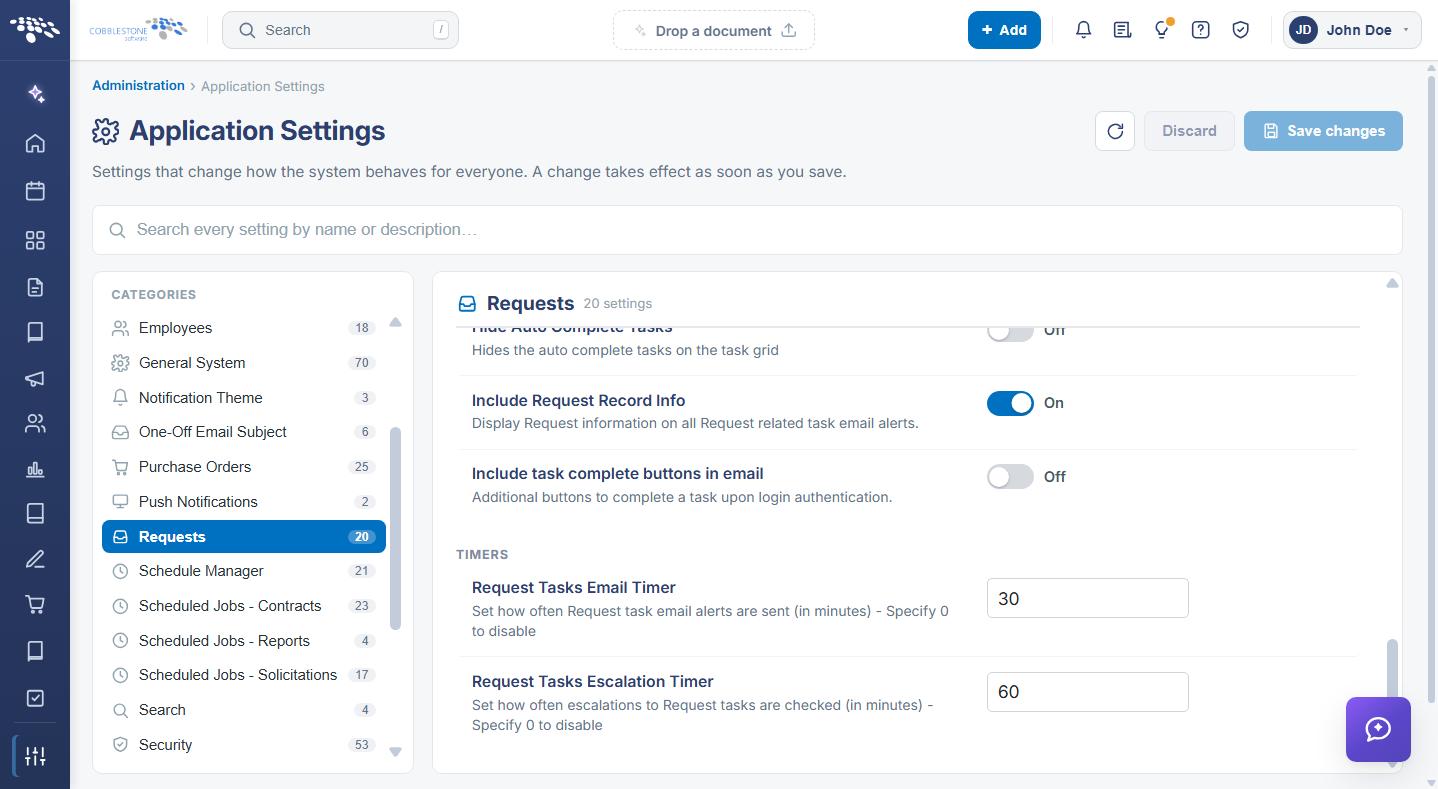
- Include Request Record Info — Displays request information on all request-related task email alerts. Toggle.
- Include task complete buttons in email — Adds buttons to the email that complete a task upon login authentication. Toggle.
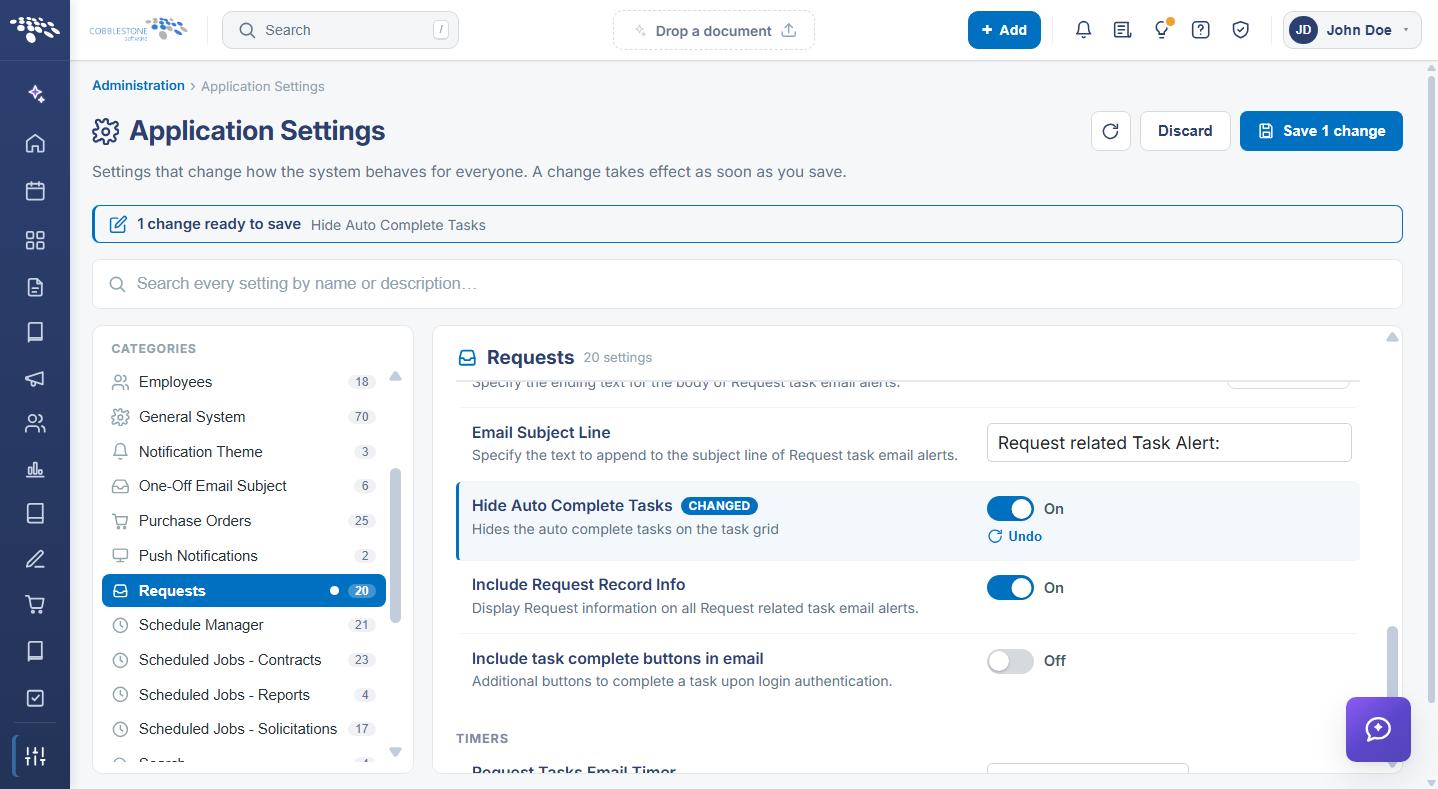
- Hide Auto Complete Tasks — Hides auto-complete tasks on the task grid. Toggle.
The Email Body Beginning Text, Email Body Ending Text, and Email Subject Line settings together compose the request task alert message — the subject line text is appended to the alert subject, and the beginning and ending text wrap the task details in the body of the message.
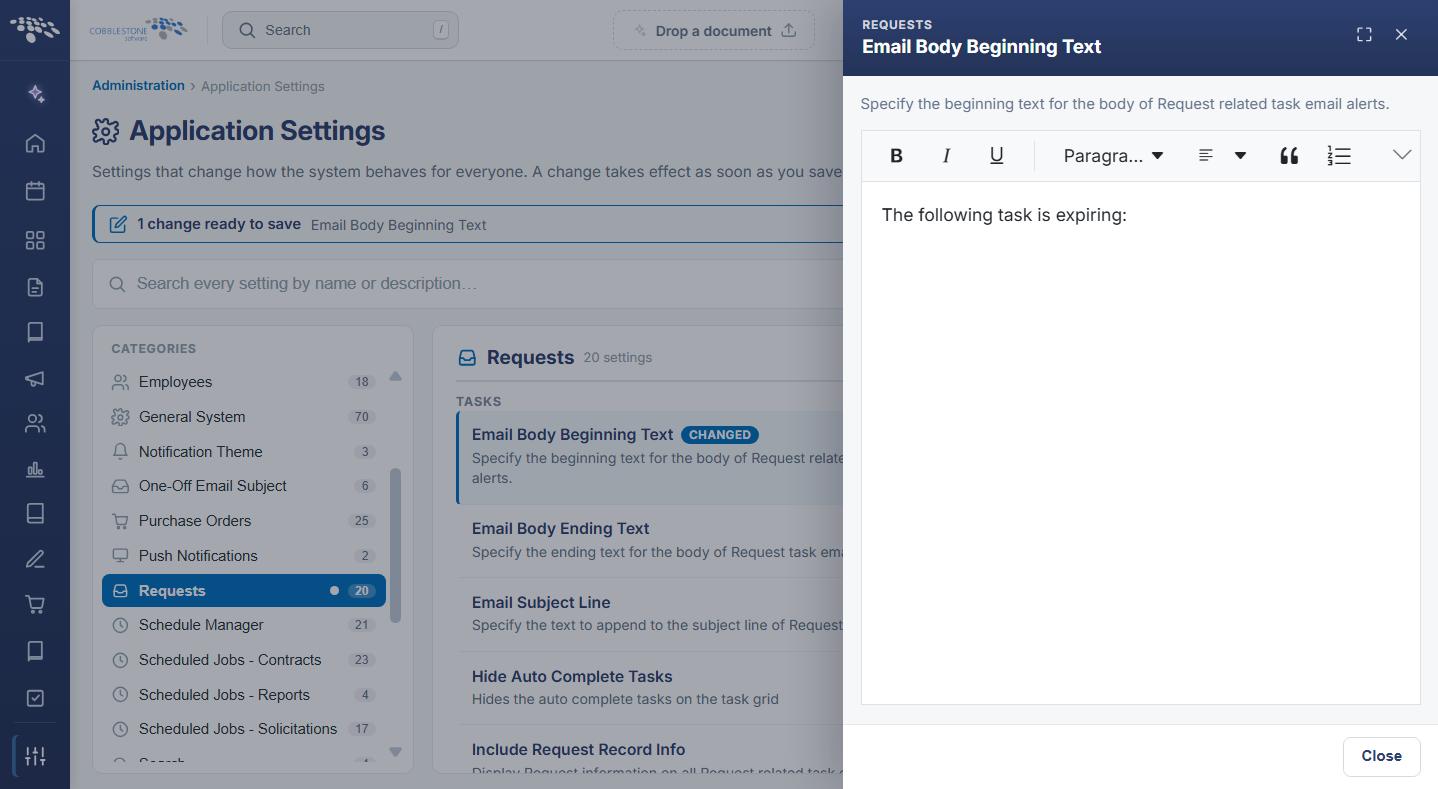
To edit one of the rich-text task email settings:
- From the Contract Insight homepage, click Administration at the bottom of the left navigation menu. On the Administration page, under Configuration & Fields, select Application Settings, then click Requests in the CATEGORIES rail.
- Under TASKS, locate Email Body Beginning Text or Email Body Ending Text and click Edit content on the setting row.
- A drawer slides out from the right, headed REQUESTS and the setting name, with the setting’s description beneath it and the current content loaded into the editor.
- Edit the content using the editor toolbar — Bold, Italic, and Underline, a Paragraph format dropdown, Blockquote and list controls, Insert Hyperlink and Insert Image, Code View for the underlying HTML, and Undo and Redo.
- Click Close to return to the settings list, then Save changes in the upper right to commit the new content, or Undo on the setting row to put it back to the saved content.
8. TIMERS Settings
The TIMERS subsection sets how often request task alerts and escalations run. Both are entered in numeric text boxes:
- Request Tasks Email Timer — How often request task email alerts are sent, in minutes. Specify 0 to disable.
- Request Tasks Escalation Timer — How often escalations to request tasks are checked, in minutes. Specify 0 to disable.
9. Modifying a Requests Setting
Function: Changes the value of a Requests setting for the entire system.
Steps:
- From the Contract Insight homepage, click Administration at the bottom of the left navigation menu. On the Administration page, under Configuration & Fields, select Application Settings, then click Requests in the CATEGORIES rail.
- Locate the setting by name under its subsection heading, and read its description to confirm what the value controls.
- Change the value using the control on the right of the setting row — a toggle, a text box, a numeric text box for the two timers, the Line Item Type for PO and Request dropdown, or Edit content for the rich-text settings.
- The setting is marked with a CHANGED badge, an Undo link appears beneath it, a dot appears beside Requests in the CATEGORIES rail, and a banner at the top of the screen reports how many changes are ready to save.
- Click Save changes in the upper right to commit the change, or Discard to put every changed setting back to its saved value. Undo on the setting row reverts that one setting only.
Caution: A change takes effect as soon as it is saved and applies to every request record and every user. Setting either timer to 0 stops the related alerts from being sent at all, and changing Line Item Type for PO and Request changes how line items are entered on new records, so confirm the intended behavior before saving.
10. Related Request Settings
The Requests group holds the behavior of request records. Several related settings are maintained elsewhere:
- Default the Department Field on Request Records — in the Contracts configuration group, under the CONTRACT heading
- Purchase Orders — a separate configuration group covering purchase order records, which shares the Line Item Type for PO and Request setting
- Schedule Manager — the system-wide job frequencies that drive scheduled email alerts and integrations
- Catalog & Items — the setup area the Items Table and Shopping Cart line item types draw on
11. Quick Reference Summary
Task | How to Complete It |
Open the group | Homepage → Administration → Configuration & Fields → Application Settings → Requests. |
Allow status changes | Request Details Page Status Changes toggle, then Save changes. |
Email on status change | Enable System Emails for Requests toggle, then Save changes. |
Choose line item entry | Line Item Type for PO and Request dropdown — Free Text, Items Table, or Shopping Cart. |
Add links to alerts | Display Link for Request Details, Display Link for Request Tasks, and Display Social Media Links toggles. |
Change task alert wording | Edit content on Email Body Beginning Text or Email Body Ending Text; Email Subject Line is a text box. |
Set the alert reply address | Reply To Address for Request Tasks under GENERAL, then Save changes. |
Set task alert frequency | Request Tasks Email Timer and Request Tasks Escalation Timer, in minutes (0 disables). |
Show budget warnings | Show Budget/Spend Alerts on Request Details Screen toggle (PO module). |
Show the vendor score card | Show / Hide Score Card Summary On Contract Details Screen toggle. |
Help catalog item searches | Edit content on Purchase Request Item Search Help under ITEMS. |
Undo a change | Undo on the setting row, or Discard in the upper right, before saving. |